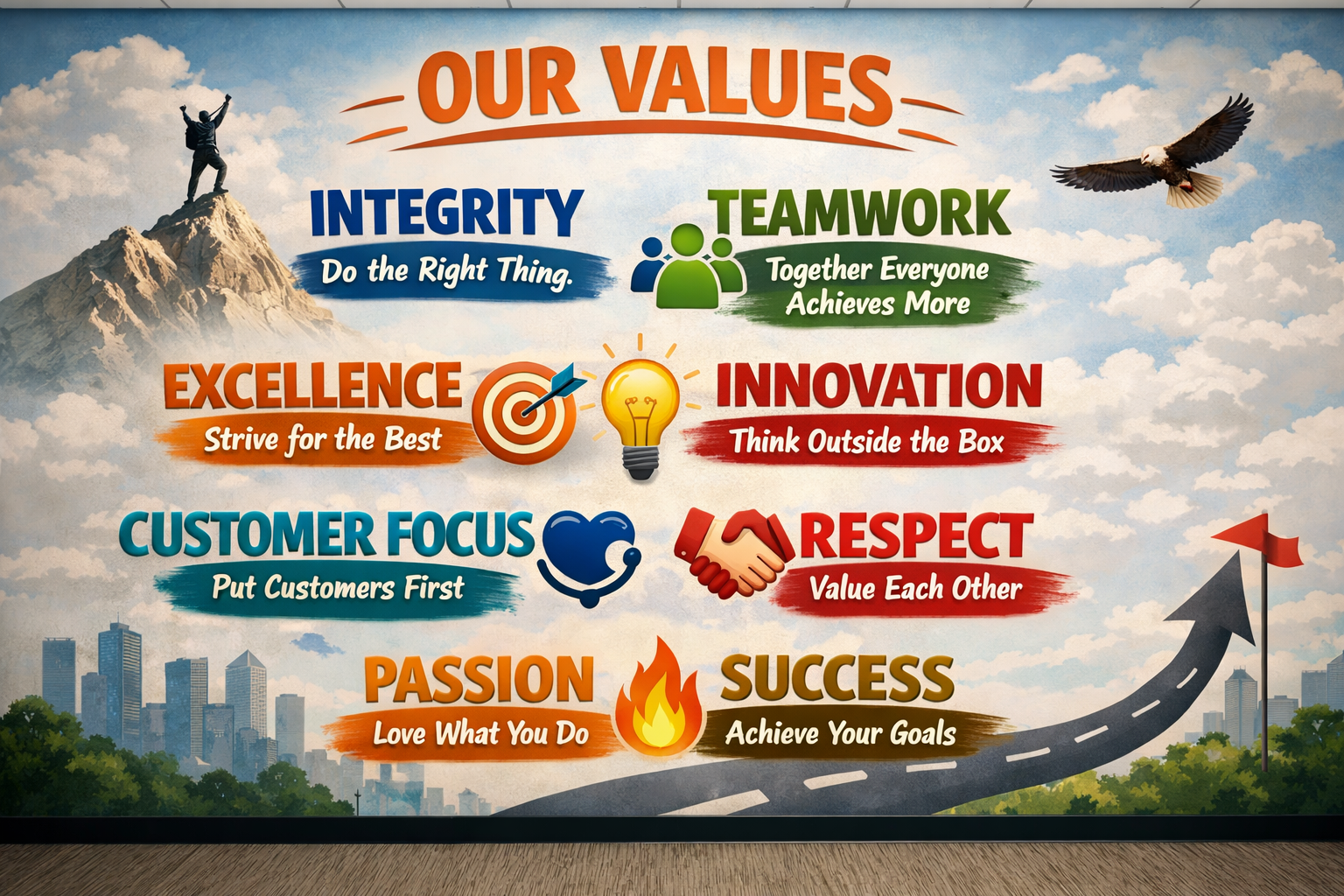
This image was created using AI, we sincerely hope businesses aren't taking this approach for building their company values.
Let's get real for a second: most organisations can rattle off their values without missing a beat. They're plastered on office walls, baked into slide decks, and proudly rolled out at all-hands meetings. Ask a leadership team what they stand for? You'll get a clear, confident answer.
Ask the rest of the team how those values show up day to day? *Crickets.*
This gap—between stated values and lived behaviour—is where culture quietly breaks down. Not because leaders don't care, but because values are often treated as beliefs rather than behaviours. And here's the uncomfortable truth: culture doesn't live in what we believe. It lives in what we repeatedly do.
The research backs this up. The Edelman Trust Barometer consistently shows that trust in organisations is shaped less by what leaders say and far more by whether their actions align with their words. When that alignment slips, trust erodes fast. And once trust is gone? Engagement, performance, and retention tend to follow it straight out the door.
Take "transparency" as an example. As a belief, it sounds great. As a behaviour, it becomes very specific: leaders share context, explain decisions, admit uncertainty, and communicate early—even when the message is uncomfortable. Without those behaviours? Transparency is just a nice-sounding word on a poster
This is where many organisations get stuck. Values are defined at the level of intent but never translated into what they actually look like in meetings, feedback conversations, decisions under pressure, or moments of failure.
Psychologist Albert Bandura's social learning theory helps explain why this matters so much. Humans don't learn what's important through policies or posters. We learn by watching others—particularly those with power and status. In organisations, that means leaders. What leaders pay attention to, tolerate, reward, or ignore quickly becomes the real value system, regardless of what's written down.
In other words, values aren’t taught. They’re caught.
This shows up in the small moments: A leader who says 'we value learning' but shuts down questions, who talks about 'ownership' but avoids accountability, who champions 'work-life balance' but sends midnight emails—each behaviour teaches people what really matters here.
The questions that matter:
Each response teaches people what's truly valued here.
Leading by example doesn’t mean being perfect. Throwback to psych safety above and years of research from Dr. Amy Edmondson shows that leaders who model vulnerability and fallibility create stronger learning cultures than those who try to appear infallible. When leaders acknowledge mistakes, ask for input and show they are still learning, they make it safer for everyone else to do the same.
Netflix's culture of freedom and responsibility is legendary. No vacation policy. No expense approvals. Employees trusted to make judgment calls that would require three layers of sign-off elsewhere. But this only works because leaders consistently model high trust, candid feedback, and clear context.
The famous "keeper test" asks managers: "Which of your people, if they told you they were leaving, would you fight hard to keep?" If the answer is no, give them a generous severance and hire someone great. It sounds brutal. It's meant to create a culture of excellence where everyone pulls their weight and no one carries dead wood.
Leaders at Netflix don't just preach this—they live it. They share context openly, explain the "why" behind decisions, and expect people to disagree loudly if they think the call is wrong. The bet is that adults, given full context and high trust, will make better decisions than any policy manual could enforce.
But here's the tension: Recent reports on employee forums suggest a culture shift from "candor" to "fear-based." Some employees describe the environment as less about psychological safety and more about performance anxiety. When "freedom" comes with the constant threat of being deemed not good enough, does it still feel like trust? Or does it start to feel like surveillance?
The question worth asking: How might these new behaviours shift the culture? If fear replaces candor, people stop challenging ideas. If everyone's worried about the keeper test, they stop taking risks. And if that happens, Netflix's high-performance culture could quietly become a high-anxiety one—where the stated values are freedom and responsibility, but the lived experience is something else entirely.
Salesforce built its "Ohana" (family) culture through concrete behaviours, not slogans. From day one in 1999, founders committed 1% of equity, 1% of product, and 1% of employee time to charity—before they had profits to give. CEO Marc Benioff doesn't just approve the 56 hours of Volunteer Time Off every employee gets—he takes it himself and posts about it. Leaders are measured on how well they drive culture, and managers' bonuses depend on values alignment scores.
But here's where it gets real: In 2015, employees raised pay equity concerns. Instead of dismissing it, Salesforce conducted a company-wide audit, found unexplained gaps, and spent $3 million to fix them. They've repeated the audit annually since, spending over $17 million closing pay gaps. That's not talk. That's turning "equality" from a poster into people's paychecks.
The result? Fortune's 100 Best Companies to Work For list 17 consecutive years, climbing from #23 to #8 while growing from 7,000 to 76,000+ employees.
The reality check: Salesforce laid off 10% of its workforce in 2023. CEO Benioff's rambling, evasive all-hands call left employees asking in Slack: "Should we retire the phrase Ohana?" Culture requires constant vigilance—and authentic leadership during crisis, not just celebration.
When Ben Cohen and Jerry Greenfield sold Ben & Jerry's to Unilever in 2000 for $326 million, critics predicted the end of the brand's activism. Twenty-five years later, the founders are still getting arrested at protests—and the company is suing its own parent company to protect its values.
The acquisition agreement gave Ben & Jerry's an independent Board with legal authority to sue Unilever—at Unilever's expense—if the parent violates the social mission. That's not symbolic. In 2022, Ben & Jerry's sued Unilever over the sale of their Israeli business. In 2025, when Unilever removed their CEO for his "commitment to the social mission," Ben & Jerry's filed another lawsuit. The tension is public and ongoing.
The proof is in the behaviours: 7.5% of pre-tax profits donated annually since 1985—a percentage that has never dropped, not during recessions, not during corporate pressure. Employees serve on Community Action Teams with real authority to make funding decisions. Ben Cohen was arrested at a Gaza ceasefire protest in 2024. He's 73 years old. That's not talk. That's behaviour.
The uncomfortable truth: The company admits "nothing we do is sustainable." Investigative journalists found serious supply chain issues—workers in supplier factories earning 25% of a living wage, emissions up 25%. But they publish it all in annual Social & Environmental Assessment Reports. Most companies bury bad news. Ben & Jerry's puts it on their website and keeps fighting for the mission.
So how do you bridge the gap? Here's where to start:
1. Translate your values into observable, measurable behaviours
For each value, ask: What does this actually look like? What would someone see or hear if this value was being lived? Be specific. "Collaboration" isn't helpful. "Actively seeking input from other teams before making decisions" is.
But don't stop there. Make it measurable at every level:
If you can't measure it, you can't manage it. And if you're not tracking whether the behaviour is happening, you're just hoping culture will take care of itself.
2. Embed values into your processes and ways of working
Values can't live only in all-hands meetings. They need to be woven into how work actually gets done.
Ask yourself: Where are the decision points in our organisation? Those are your opportunities.
3. Create accountability mechanisms that actually have teeth
It's not enough to say values matter. You need structures that hold people accountable when they're violated—especially leaders.
4. Make leadership behaviour visible
When leaders model this consistently, it gives everyone else permission to do the same.
5. Call out the behaviours you want more of
When you see someone living a value, name it. Public recognition reinforces what matters and gives others a blueprint to follow.
But be specific. Don't just say "Great job on that project." Say, "I noticed you proactively reached out to the product team for their input before finalising the design. That's exactly what collaboration looks like here, and it made the outcome stronger."
That level of specificity tells everyone: This is what we mean when we say we value collaboration.
6. Create feedback loops that actually close
Don't just ask for feedback. Show what you've done with it. This is non-negotiable if you want a culture where people speak up.
When someone gives you feedback:
Even when you can't act on the feedback, explain why. Transparency about constraints builds more trust than silence.
7. Measure what matters—internally AND externally
Your values show up in two arenas: how you treat your people (internal) and how you show up in the world (external). Both matter.
Internal measures:
External measures:
Culture changes when values become measurable, when leaders are held accountable for behaviour not just results, and when the entire organisation reflects what you say you stand for
If the gap between your stated values and lived culture is bigger than you'd like, the good news is you have the power to change it. Not through better communication or prettier posters, but through the processes you redesign, the behaviours you measure, the accountability you enforce, and the small, consistent actions leaders take tomorrow. And the day after that. And the day after that.
Because culture isn't what you say in the all-hands. It's what you do in the room—and what you build into how work gets done
If you enjoy both boat puns and great insight on all things People, Culture + Leadership, then sign up for our newsletter Unleashed Thinking. One email per month, no spam.


If you are located elsewhere, pop us a 📩 and we will see what we can do!

